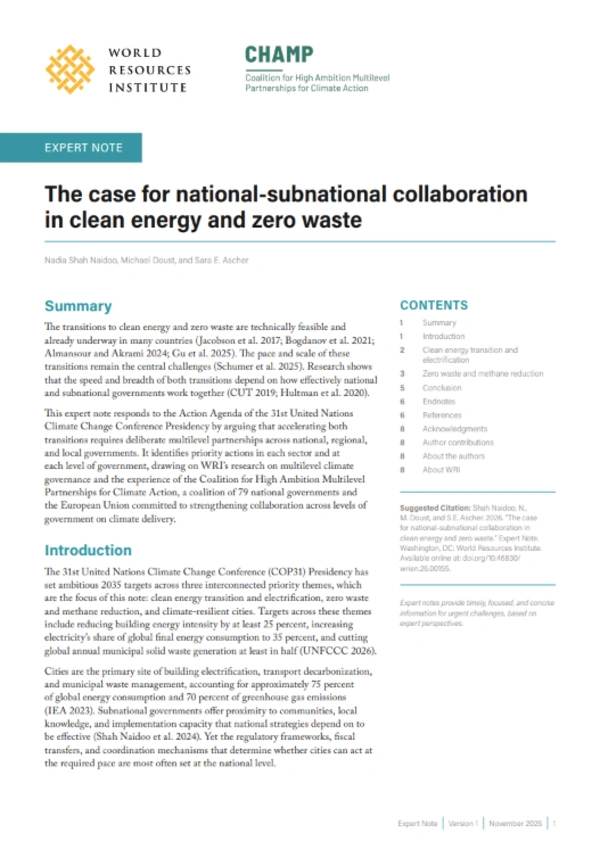
The Case for National-Subnational Collaboration in Clean Energy and Zero Waste
This Expert Note sets out concrete priority actions at national, regional and local level across four areas: legal authority, financing and investment, coordination and system planning, and capacity support. It draws on WRI’s research on multilevel climate governance and the experience of CHAMP.
- Authors
- Nadia Shah Naidoo, Michael Doust, Sara Ascher
- Organization
-
 World Resources Institute
The transitions to clean energy and zero waste are technically feasible and already underway in many countries. The pace and scale of these transitions remain the central challenges. Research shows that the speed and breadth of both transitions depend on how effectively national and subnational governments work together. This expert note responds to the Action Agenda of the 31st United Nations Climate Change Conference Presidency by arguing that accelerating both transitions requires deliberate multilevel partnerships across national, regional, and local governments. It identifies priority actions in each sector and at each level of government, drawing on WRI’s research on multilevel climate governance and the experience of the Coalition for High Ambition Multilevel Partnerships for Climate Action, a coalition of 79 national governments and the European Union committed to strengthening collaboration across levels of government on climate delivery.
Four key action areas that if strengthened will increase likelihood of successful transitions:
- Legal authority: subnational governments are often trying to act faster than the frameworks allow. Beyond setting targets, national governments have an important role to play in creating the enabling conditions for implementation.
- Financing and investment: in too many countries, national targets are set without corresponding funding for local delivery. Finance and reduction targets have to be planned together from the start.
- Coordination and system planning: the energy, transport and waste transitions are interconnected. Electricity infrastructure cannot be planned without accounting for EV uptake. Waste reduction cannot be planned without aligning collection systems with regional treatment capacity. This planning has to happen jointly across levels.
- Capacity support: even where the frameworks and finance are in place, delivering these transitions at local level requires specialized technical expertise that many subnational governments do not yet have. That means dedicated technical assistance to translate national requirements into local practice, regional pooling of expertise to reach smaller municipalities, and structured peer learning so cities and regions can learn from each other.